
The Seller May Still Owe You a Washing Machine Fix After the Warranty Ends
 Hamish Ogilvie
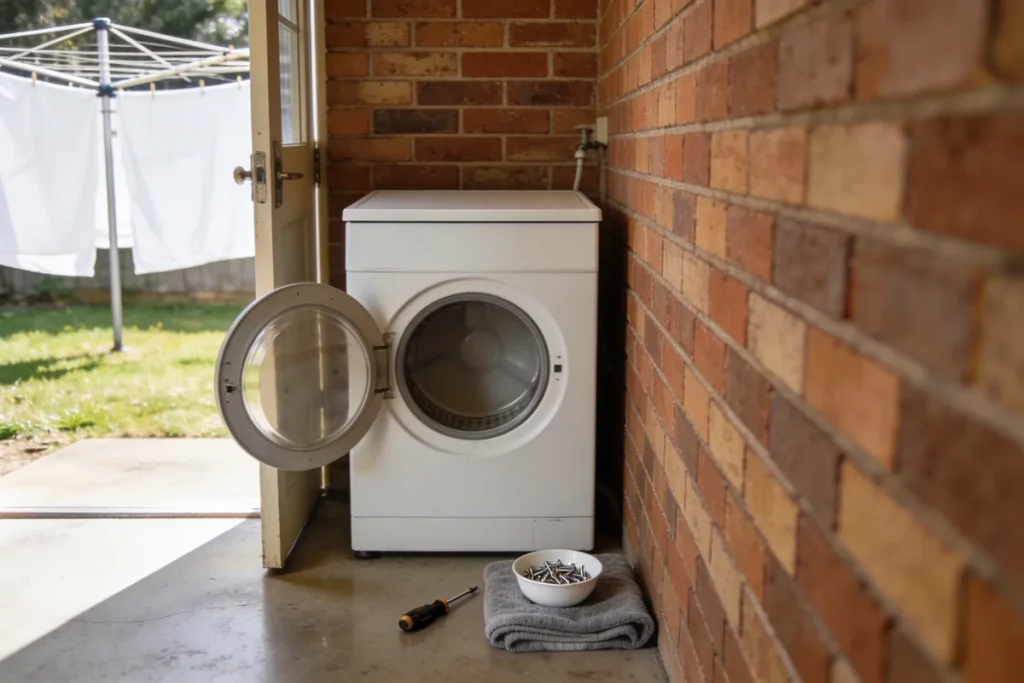
A washing machine that stops mid-cycle with a drum full of water sets off a predictable sequence. The householder rings a repairer, receives a quote, and sets that quote against the price of a new machine in a shop window. Two questions sit on either side of that comparison and usually go unasked. The earlier one is who owes the fix at all. The later one is what the sum really says once the age of the machine and the years left in it are counted. The calculator below handles the later question on the reader’s own numbers. It takes a callout fee, a repair quote, a new price and two guesses at how long each machine will last, then returns a cost for each year. It supplies no figures of its own, and it cannot answer the earlier question, which is what the rest of this post covers. This is general information, not legal advice.
Run the repair-or-replace sum
Type your own numbers. Nothing is filled in for you.
Without scripts: add the callout to the repair quote and divide by the years you expect from the repaired machine; divide the new price by the years you expect from a new one.
Enter the repair quote to start.
Put the callout in as a cost even if the repairer says it is credited when you go ahead; enter 0 only if it is credited.
The two year figures are your own estimates. The sum cannot see the fault, the model or whether parts exist.
This does not say whether the seller owes you the repair. Ask that first, as above.
What the law says about how long a washing machine should last
Goods sold to consumers in Australia must be of acceptable quality under the Australian Consumer Law, and acceptable quality includes durability. The law sets no number of years for any product. According to joint guidance from the ACCC and every state and territory regulator, published on 2 November 2022, durability is judged by what a reasonable consumer would expect, taking in four things: the nature of the goods, the price paid, any statements made about them, and the other circumstances of the sale. A manufacturer’s warranty is a separate promise and does not cap that guarantee. The ACCC made the same point in a media release on 18 January 2024: a product that breaks after its warranty has expired may still be covered.
The guidance includes a worked example that settles more than most commentary does. Two consumers, Lara and Jessica, use two machines in the same way. One machine cost $1,250 and the other $400, and in each the motor fails at five years. The regulators say Lara, with the $1,250 machine, could claim, and that Jessica, with the $400 machine, may not be able to. The facts are identical, five years and a failed motor, yet the answers differ because price changes what a reasonable consumer expects.
That example answers a line common among householders online, that six years is a fair life for a washer and anything after the warranty is the owner’s problem. For a budget unit six years can be a reasonable life, and the ACCC’s own example concedes as much. It is a judgement about one machine, though, not a rule about all of them, and a dearer machine that fails at five years may well be covered.
One boundary applies before anything else. The guarantee covers goods supplied in trade or commerce, so a one-off private sale, where the seller is not running a business, falls outside most of the guarantees.
Who to ask first, and what can be asked for
The first request goes to the seller, not the manufacturer. A seller cannot simply send the buyer off to the manufacturer, with one exception: where spare parts or repair facilities are not available a reasonable time after purchase. A seller who says “ring the maker” is therefore worth asking whether that exception applies.
What the buyer can ask for depends on whether the problem is minor or major.
| Type of problem | What the consumer can ask for |
|---|---|
| Minor | A repair at no cost, within a reasonable time. If the seller cannot or will not, the buyer can have it fixed elsewhere and claim the reasonable cost |
| Major | A refund or a replacement, the consumer’s choice, or keep the machine and seek compensation for the drop in its value |
Two further points shape how this plays out. A series of minor faults can add up to a major one, a point made in a column by Western Australia’s Commissioner for Consumer Protection on 2 July 2026. And the ACCC does not settle individual disputes. That job belongs to the state or territory consumer agency, which is where a householder who gets nowhere with the seller goes next.
None of this promises an outcome. Whether a particular failure breaches the guarantee turns on price, use and what a reasonable consumer would expect, and a regulator or tribunal makes that call, not a calculator. Extended warranty products are a separate matter and sit outside this post.
The first message to the seller
The ACCC’s advice on contacting a business is to put the request in writing and to include a short list of facts. It needs no legal language and no threats. Five plain lines do the job.
- The problem: what the machine does, or has stopped doing, in a sentence.
- The dates: when it was bought and when the fault first appeared.
- The paperwork: the receipt or invoice, attached.
- The outcome wanted: a repair, or, where the fault is major, a refund or replacement.
- The time allowed: a reasonable period to reply, with the actual date written in.
A hypothetical version, with the brackets filled in by the reader, runs along these lines: “I bought the washing machine on the attached invoice on [date]. On [date] it stopped [describe the fault]. I believe this is a failure of the consumer guarantee of acceptable quality and I would like it repaired at no cost. Please reply in writing by [date].” The outcome line should match the seriousness of the fault, because asking for a refund over a minor problem starts the exchange on the wrong footing.
Keeping the exchange in writing gives both sides a record. It also gives a state or territory agency something concrete to read if the dispute ever reaches one.
If you are paying: what the quote should say
Sometimes the guarantee does not reach the fault, the machine was bought privately, or the seller has closed. In those cases the householder is paying, and the quote deserves the same attention as any other. Four lines should be on it in writing.
- The fault and the part: what has failed, and what the repair replaces.
- Parts and labour, split: two figures, not one lump.
- The callout: whether the fee is credited against the repair if the householder goes ahead.
- The warranty on the repair: how long the work and the new part are covered.
Whether parts are available belongs in the same conversation, since a repair quote for a part that cannot be sourced is not a quote worth much. For what a diagnostic fee should buy, the auto electrician or mechanic comparison sets out the reasoning on a different kind of machine, and it carries over. For reading a repair quote line by line, the garage door spring repair guide does the same for a trade where one fault can hide several. Householders choosing a technician can start with the appliance repairs listings for home and kitchen, where each business states what it services.
Why one rule of thumb is not enough
The most repeated rule is the half-price rule: if the repair costs more than half the price of a comparable new machine, replace it. Repairers and retailers both repeat it, usually with an age test attached. It survives because it takes ten seconds to apply. It is also blunt, and the rest of this section shows where.
Choice, the consumer organisation, publishes several yardsticks that do not line up neatly. Its replacement guidance on washers, updated on 8 May 2023, puts age markers on the decision: 12 years for a front loader, 7 for a top loader, and a major failure after six years usually pointing to a new machine. Its note on kitchen appliances, updated on 10 November 2025, gives at least seven years for dishwashers. Separately, its lifespan list, updated on 20 March 2024, gives 10 years for a washer and 9 for a dishwasher. A later Choice page, dated 17 August 2026, mentions a 10 to 15 year lifespan for dishwashers. Choice’s own dishwasher pages disagree, and the disagreement is not small, so this post does not pick one. Choice also advises that it is always worth trying to repair a washing machine, particularly one still within its life expectancy, which is a fourth test with a different answer again.
| Yardstick | What it really measures | What it misses |
|---|---|---|
| Half-price rule | The quote against the shop price | The age of the machine and the life left in it |
| Choice age markers | The machine’s age against a threshold | The size of the quote |
| Choice lifespan list | A typical life for the product type | The model, the price paid and how it was used |
| Cost per remaining year | Outlay spread over the years expected | The fault itself and whether parts exist |
The yardsticks answer different questions, which is why they appear to disagree. The ruling here is to use each for the job it does. Age markers judge the machine. The ratio judges the quote. Cost per remaining year, which is what the calculator above computes, judges both together, because it puts the repair and the replacement on the same footing, dollars for each year of use.
The sum, worked twice
Both cases below are hypothetical. The figures are made-up round numbers chosen to show how a single rule can mislead in either direction, and they are not typical prices for any repair or machine. The years are guesses, and the new-machine life of 10 years borrows Choice’s list figure for a washer.
| Case A | Case B | |
|---|---|---|
| Callout plus repair | $120 + $260 = $380 | $120 + $400 = $520 |
| New machine, delivered, installed, old one removed | $1,100 | $1,100 |
| Repair as a share of new price | 34.55 per cent | 47.27 per cent |
| Half-price rule says | Repair | Repair, but close to the line |
| Years expected from the repaired machine | 3 | 8 |
| Repair, per year | $126.67 | $65 |
| New machine, per year at 10 years | $110 | $110 |
In Case A the half-price rule says repair, since 34.55 per cent is well under half. The yearly figures say otherwise. A repair that buys only three more years costs $126.67 for each of them, against $110 for each year of a new machine. The rule has pointed the wrong way, and it did so because it never asked how long the repair would last.
Case B sits close to the line. At 47.27 per cent the rule leans towards repair, but it would flip with a small change: lift the repair quote by $40, to $440, and the outlay becomes $560, just over half of $1,100, so the rule now says replace. Yet $560 spread over eight years is $70 a year, still well under $110. The rule would have sent the householder to the shop for a machine that costs more each year.
Neither case says what any real household should do. The point is narrower: a ratio alone can be wrong in both directions, and the yearly figure catches both errors. It also depends on a guess, the years the repair will buy, so the sensible habit is to run the sum twice, once with a hopeful figure and once with a cautious one, and see whether the answer survives both.
Faults that tip the sum
Some faults change the estimate before any arithmetic starts. Choice’s signs that a washer is due for replacement include a major failure after six years, which usually means a new one, persistent rust staining, and bigger leaks, which might need a repair person or even a new machine. An expensive suspension repair is also a sum worth running before agreeing to it, not after. Those are the washer faults Choice records. This post gives no price list by fault, since a figure without a source would only mislead.
A leak needs one caution before the machine is written off. Water that comes from a tap, an inlet hose or a drain is often not the machine’s fault at all, and that is a plumber’s job, not an appliance technician’s. Householders can start with the plumber listings before ruling the machine out.
Age matters for parts too. Choice notes that parts for ovens older than 10 years may be unavailable, and the same question is worth putting to any repairer quoting on an older appliance of any kind.
Ask First, Then Do the Sum
The order matters more than any single figure. Start with who owes the fix: for a durable appliance that fails early, the seller is the first to ask, and the consumer guarantee may reach well past the end of the warranty. Only if that route fails does the arithmetic count, and then cost per remaining year, read alongside the age markers, beats the half-price rule on its own. A budget machine can honestly be past a reasonable life, and the rule is not wrong so much as blunt, so give it its due and let the yearly figure have the last word.
Sources: Australian Competition and Consumer Commission with every state and territory regulator, Guidance on the consumer guarantee: acceptable quality and the meaning of durability, 2 November 2022 (https://www.accc.gov.au/system/files/acl-consumer-guarantee-guidance-durability.pdf); ACCC, Repair, replace, refund, cancel (https://www.accc.gov.au/consumers/problem-with-a-product-or-service-you-bought/repair-replace-refund-cancel); ACCC, Consumer rights and guarantees (https://www.accc.gov.au/consumers/buying-products-and-services/consumer-rights-and-guarantees); ACCC, Broken but out of warranty? Your consumer guarantee rights may still apply, 18 January 2024 (https://www.accc.gov.au/media-release/broken-but-out-of-warranty-your-consumer-guarantee-rights-may-still-apply); ACCC, Contacting a business to fix a problem (https://www.accc.gov.au/consumers/problem-with-a-product-or-service-you-bought/contacting-a-business-to-fix-a-problem); Consumer Protection WA, From the Commissioner: Don’t lose your consumer rights in the spin cycle, 2 July 2026 (https://consumerprotection.wa.gov.au/announcements/the-commissioner-dont-lose-your-consumer-rights-the-spin-cycle); CHOICE, How long should your washer, fridge, TV and other appliances last, updated 20 March 2024 (https://www.choice.com.au/shopping/consumer-rights-and-advice/your-rights/articles/how-long-should-your-appliances-last); CHOICE, How to buy a great dishwasher, updated 17 August 2026 (https://www.choice.com.au/home-and-living/kitchen/dishwashers/buying-guides/dishwashers); CHOICE, 6 signs it’s time for a new washing machine, updated 8 May 2023 (https://www.choice.com.au/home-and-living/laundry-and-cleaning/washing-machines/articles/signs-its-time-for-a-new-washing-machine); CHOICE, Is Black Friday a good time to upgrade your kitchen appliances, updated 10 November 2025 (https://www.choice.com.au/home-and-living/kitchen/ovens/articles/when-should-you-upgrade-your-appliances)