
Asbestos Removal: What You Can Legally Do Yourself, and What Has to Be Licensed
 Hamish Ogilvie
The wall you are about to open
The quote for the 1970s bathroom has arrived higher than expected, and it is hard to argue with because nobody has yet established what the wall contains. On that question, the law is more permissive than most householders assume. Every state and territory allows an owner to remove a defined small amount of bonded asbestos without a licence, and the common figure is 10 square metres of non-friable material. Friable material sits outside that allowance everywhere: it releases fibres readily when disturbed, no unlicensed person may remove it, and it needs a Class A licence rather than the Class B that covers most residential work.
Scale explains why the question keeps arriving at the start of a renovation rather than the end. The Asbestos Safety and Eradication Agency’s guidance for householders records that asbestos is common in homes built or renovated before 1990, which takes in most of the housing stock in the older suburbs of every capital city. It went into flat sheeting around wet areas, into eaves and fencing, and into a longer list of places than most owners think to check. A renovation that opens one wall can turn a paint and tile budget into a removal job in a single morning.
What follows is a vetting guide rather than a removal guide. It sets out where the unlicensed line sits, the three things a licensed removalist must be able to show, the testing that comes before any quote, and the documents that should survive the job. Requirements differ between states and territories and they do change, so the regulator in the reader’s own jurisdiction remains the authority on the rules that apply.
The half of the job you are allowed to do yourself
The unlicensed allowance is a defined limit, set by the work health and safety regulator in each state and territory and described in Safe Work Australia’s code of practice for removing asbestos. Almost everywhere it takes the same shape: a small quantity of non-friable material, measured in square metres, that an owner may remove without a licence. The differences matter before a job is measured, because Victoria and the ACT narrow the allowance in ways that can decide a small renovation.
| Jurisdiction | What an unlicensed owner may remove |
|---|---|
| Every state and territory | A defined small quantity of non-friable material, commonly up to 10 square metres |
| Victoria | The same 10 square metres with a time limit attached: no more than one person-hour in any seven-day period, and a larger job cannot be divided into 10 square metre sections to stay inside the allowance |
| ACT | Unlicensed removal is prohibited except for defined minor work |
Two constraints apply whoever does the work. Power tools are prohibited on asbestos-containing material unless the use of the equipment is controlled, while high-pressure water and compressed air are prohibited outright, because each of them puts fibres into the air in quantity, which is the outcome the whole method is designed to avoid. The risk also does not scale down with the size of the job: Safe Work Australia’s position is that there is no safe level of exposure to asbestos.
The saving on offer is real, and so is the risk that comes with it. A bonded fence, or a small sheet job inside a wet area that measures under the allowance, can be done without a contractor’s fee, and the householder who takes it on accepts the exposure risk that the licensed trade is built to control. That trade is a decision for the householder, not for a directory or for this article, and it is the reason the rest of this piece deals with everything outside the allowance: the licence, the notification, the assessor and the paperwork.
The three things a licensed removalist has to show you
When a job falls outside the allowance, three checks decide the hire, and each of them produces something that can be verified rather than taken on trust.
The licence class. Two classes of licence cover removal work, and they are not interchangeable. Class B covers non-friable material only, which is the sheeting, fencing and eaves work that makes up most of the residential market. Class A is required for friable material and for asbestos-contaminated dust and debris, the work that follows a fire, a flood or a demolition done badly. Licences run for five years, and a current licence issued in one jurisdiction is recognised in the others.
| Licence class | What it covers | When it is required |
|---|---|---|
| Class B | Non-friable (bonded) material only | Sheeting, fencing, eaves and similar residential work |
| Class A | Friable material, plus asbestos-contaminated dust and debris | Anything friable, and contamination cleanup |
The class has to match the material in front of the crew, and that is the check worth making; a licence number on its own proves very little. A Class B number quoted for a friable job is the point at which the conversation ends.
The notification. Licensed removal work must be notified to the state work health and safety regulator before it starts, and the standard notice period is five days. Victoria requires 24 hours for work at or under the 10 square metre line, which covers the case where a licensed removalist is doing a small job the owner could legally have done. Ask who lodged the notification and when, because the answer is checkable against the regulator’s own record. The notification is how the regulator knows the work is happening at all.
The clearance certificate. For friable removal at a residential property, an independent licensed asbestos assessor performs the air monitoring, and the independence is the point: a removalist cannot issue their own clearance certificate. The results go to the owner and the occupier. The enclosure is not dismantled until the readings are below 0.01 fibres per millilitre of air, and readings above 0.02 fibres per millilitre stop the work and trigger a notification to the regulator. The person who commissioned the friable removal is the person who must obtain the certificate, which places the document in the owner’s hands rather than the contractor’s. The commercial rule that follows is short: no certificate, no final payment.
Where the waste is allowed to go
Removal is only half the job. The material still exists afterwards, and the disposal rules are what a householder can verify on the day. Every load leaves the property in the same condition, whether it came from a licensed crew or from the 10 square metre allowance: double-wrapped in plastic at least 200 microns thick, every seam taped, and the parcel labelled. From there it goes to a landfill licensed to accept asbestos. It does not go into a kerbside bin, and it does not go into a general skip, however well wrapped it is.
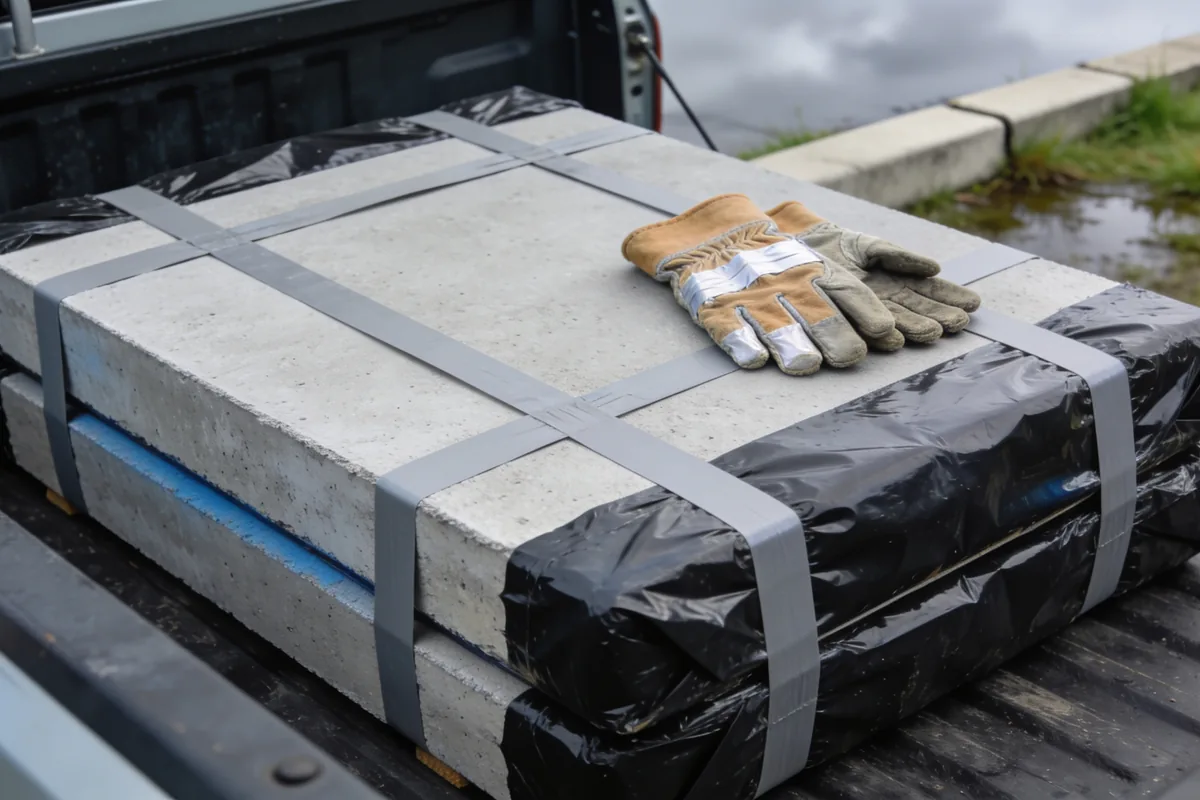
In New South Wales there is a further step for larger loads. Anything above 100 kilograms or 10 square metres must be tracked through the Environment Protection Authority’s Waste Locate system, which follows the material from the site to the landfill that receives it. The householder’s record of the whole chain is the docket from the tip, and it belongs beside the clearance certificate.
Disposal is the step where a job’s true cost is easiest to hide, and the penalties in each state are set accordingly. In New South Wales, unlawful disposal carries maximum penalties of $2 million for a corporation and $500,000 for an individual, under offences introduced in 2019. Individuals in Western Australia face up to $10,000, and serious illegal dumping in Victoria runs past $50,000. The wrap is also the one part of a licensed job that can be checked directly: a sealed, double-wrapped, labelled parcel leaving the property is the visible evidence that the crew is following the method it was hired for.
Testing: the one receipt worth having before any quote
Every figure in a removal quote is an inference until the material has been identified, and identification is a laboratory job. A sample goes to a laboratory accredited by the National Association of Testing Authorities, and the result is a statement about the material rather than an opinion about the house. There are two ways to get the sample: follow the householder guidance published by the Asbestos Safety and Eradication Agency, which is written to avoid breaking the material, or ask a licensed assessor to take it and report.
The test is the least expensive step in the whole exercise, and everything after it follows from the result. A bonded result can bring a small job inside the unlicensed allowance. A friable result takes it outside the reach of anyone without a Class A licence. Where a quote has been prepared without a test, the comparison is between guesses, and the number that looks lowest may simply be the one that assumed the least. Until a laboratory has examined a sample, nobody in the conversation knows what the material is.
How to compare the quotes once you have them
Across a set of quotes for the same job, the totals are the least informative part. A quote is a fixed price for defined work; an estimate is a prediction that can move, and the two words are not interchangeable. Beyond that, the comparison is a list of line items, and the quote that names them is the only one that can be compared honestly.
| What a real quote names | What a lump sum leaves out |
|---|---|
| The licence number and its class | A number with no class attached |
| The notification to the regulator, and who lodged it | Silence on whether the regulator knows about the job |
| The air monitoring, and the independent assessor who performs it | Monitoring folded into the price with no assessor named |
| The clearance certificate, and who obtains it | A promise that the site will be clean, with no document behind it |
| The wrap, and the tip fees, as separate lines | Disposal folded into a single figure with no destination named |
| Whether access, scaffolding or height changes the method | A price built on a method nobody has checked |
A removal price is assembled from four drivers: the volume of material, whether it is friable or bonded, the access to it, and the disposal distance and fees. Two quotes for the same bathroom can differ because they priced different volumes, different methods or different disposal arrangements, and the line items are the only place that difference can be seen. Anyone who has spent years reading quotes from subcontractors will recognise the pattern: the longest quote is not automatically the most expensive, and the shortest is not automatically the cheapest. The assumptions behind each total are what the comparison should turn on.
Underneath all of it sits the consumer-law baseline, which does not move with the paperwork. Services must be carried out with due care and skill, and no quote, however detailed, displaces that obligation.
The paperwork that proves it is gone
When the work is finished, the evidence that it was done properly is a short set of documents, and each one exists because somebody who asked for it was entitled to see it.
- The licence held by the removalist, and its class, matched to the material that was removed.
- The notification lodged with the state regulator, and the date it went in.
- The name of the independent licensed assessor who performed the air monitoring.
- The clearance certificate, obtained by the person who commissioned the work, with readings below 0.01 fibres per millilitre before the enclosure came down.
- The waste docket from a landfill licensed to accept asbestos.
A directory’s role in all of this is narrow, and worth stating plainly: it shows which businesses are operating near a given suburb, and nothing more. The checks above decide whether one of them is the right business for the job, and the documents prove afterwards that the work was done to the standard the law requires.
The clearance certificate and the waste docket outlast the crew, the trailer and the scaffolding. They are the record of what was removed and where it went, and that record is the reason each check above belongs before a deposit changes hands rather than after the work is finished.
Sources: Safe Work Australia, How to Safely Remove Asbestos: Code of Practice (2020) · Safe Work Australia, Model Work Health and Safety Regulations (5 December 2025 compilation), regs 446, 466, 474-477, 485-488 and 503 · Occupational Health and Safety Regulations 2017 (Vic), regs 250 and 298 · WorkSafe Victoria, Removing Asbestos in Workplaces: Compliance Code (2019) · Dangerous Substances (General) Regulation 2004 (ACT), ss 311-312 · Asbestos Safety and Eradication Agency, Householders and Home Renovators · SafeWork NSW, Removal and Disposal of Asbestos · NSW Environment Protection Authority, asbestos waste and unlawful disposal · Environment Protection Authority Victoria, asbestos disposal and illegal dumping · Government of Western Australia, asbestos waste disposal · ACCC, Consumer Guarantees: Services