
A Bathroom Exhaust Fan Now Has to Vent Outdoors, Not Into the Roof Space
 Marco Pellegrini
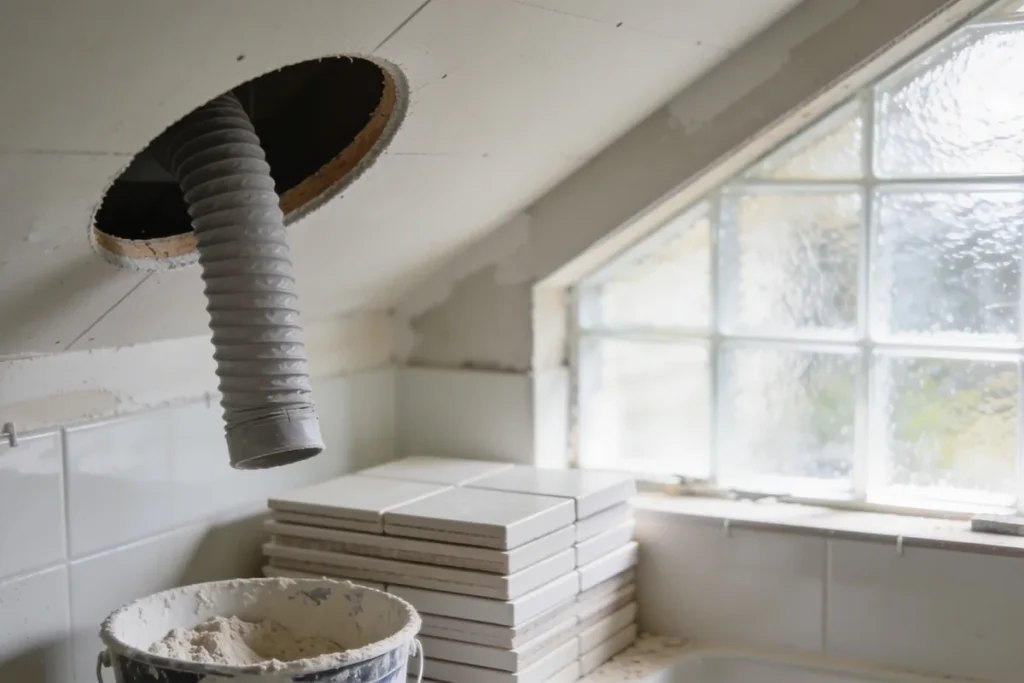
Picture an electrician lifting a ceiling panel in a bathroom and finding the end of a flexible duct resting in loose insulation, pointing at nothing. The fan below has run for years. Whatever it pulled out of the room stopped in the roof space. The quote that started the job had one word for it: “ducted”.
That word is the gap this post is about. Our position is a plain one: ask the quote to say the fan discharges to outdoor air through a named outlet (an eave, a wall or the roof), not just that it is “ducted”. The national building code’s pathway for new work asks for exactly that. An earlier edition also allowed a bathroom fan to feed a ventilated roof space, and that second option is no longer there.
A word on limits. This is general information, not building or electrical advice. It covers the states where the code’s published adoption dates could be pinned down. Queensland is outside it, because the table we read points to a Queensland site and gives no date, so we have left it alone. Ask your building surveyor which rules apply to your job.
What the Code Said, and What It Says Now
The National Construction Code is published in editions, and the part that covers condensation management in houses is Part 10.8 of the Housing Provisions (it was Part 3.8.7 in the 2019 edition). Two terms are worth knowing. “Deemed-to-satisfy” simply means the set of prescriptive rules that, if you follow them, are accepted as meeting the code. A Performance Solution is the other path: a design that departs from those rules and is assessed and accepted by the building surveyor.
On the deemed-to-satisfy path, the wording on where a bathroom fan sends its air has changed:
| Edition | What it says about a bathroom fan’s discharge | Clause |
|---|---|---|
| NCC 2019 | Exhaust goes “directly or via a shaft or duct to outdoor air”, or to a roof space that is ventilated to the code’s formula | 3.8.7.3(b) and 3.8.7.4 |
| NCC 2022 | Exhaust “must discharge directly or via a shaft or duct to outdoor air”. No roof-space option | 10.8.2(2) |
| NCC 2025 | Same words as 2022 | 10.8.2(2) |
The 2019 roof-space option came with conditions. The roof space needed openings spread evenly, with a total unobstructed area of one three-hundredth of the ceiling area where the roof pitch is above 22 degrees, or one one-hundred-and-fiftieth where it is at or below 22 degrees. Thirty per cent of that area had to sit within 900 mm of the ridge, the rest at the eaves. So the claim in public discussion that venting into the roof was “fine” has some basis: it was lawful under the 2019 text if the roof space met that formula. What changed is that the 2022 and 2025 deemed-to-satisfy text no longer offers it.
The flow rate did not move. A bathroom fan is rated at not less than 25 litres a second in the editions we read.
Why does it matter? A Victorian Building Authority notice of 9 June 2022 reported a rise in complaints about fans discharging into unventilated roof spaces. It said this could lead to condensation, mould growth and degradation of structural members.
Which Edition Applies Where You Live
There is no single answer, and the code itself says why. Each state and territory decides when an edition takes effect. This table sets out the dates in ABCB’s two published adoption pages. The 2022 dates come from a table the ABCB marks as correct as at 22 September 2023, and neither page shows a later revision date, so treat the table as the published position and not a promise nothing has changed.
| State or territory | NCC 2022 condensation provisions | NCC 2025, as at 10 August 2026 |
|---|---|---|
| NSW | 1 October 2023 | Has not yet been adopted (ABCB lists 1 May 2027). The 2025 NSW schedule says Part 10.8 of the 2022 Housing Provisions continues to apply |
| Victoria | 1 May 2024 | 1 May 2026 |
| ACT | 15 January 2024 | 1 May 2026, with a 12-month transition |
| WA | 1 May 2025 | 1 May 2026, with a 12-month transition |
| SA | 1 October 2024 | Building code has not yet been adopted (ABCB lists 1 May 2027) |
| Tasmania | 1 October 2023 | ABCB lists 1 May 2027 and notes a temporary adoption from 1 May to 4 June 2026, with a transition period from 5 June 2026 to 1 May 2027, so ask about Tasmania’s current position |
| NT | 1 October 2023 | Not adopted |
Two honest points. The 2025 edition lists state variations to Part 10.8 for NSW and Tasmania only. Both point back to the 2022 text: the NSW schedule says Part 10.8 of the 2022 Housing Provisions applies in NSW, and the Tasmanian schedule replaces Part 10.8 with the 2022 Part 10.8. And a date on this table is the date an edition takes effect, not the date it reaches your project. Which edition applies to your job depends on your state and on when the permit is issued, so ask the building surveyor.
What a Quote Should Say
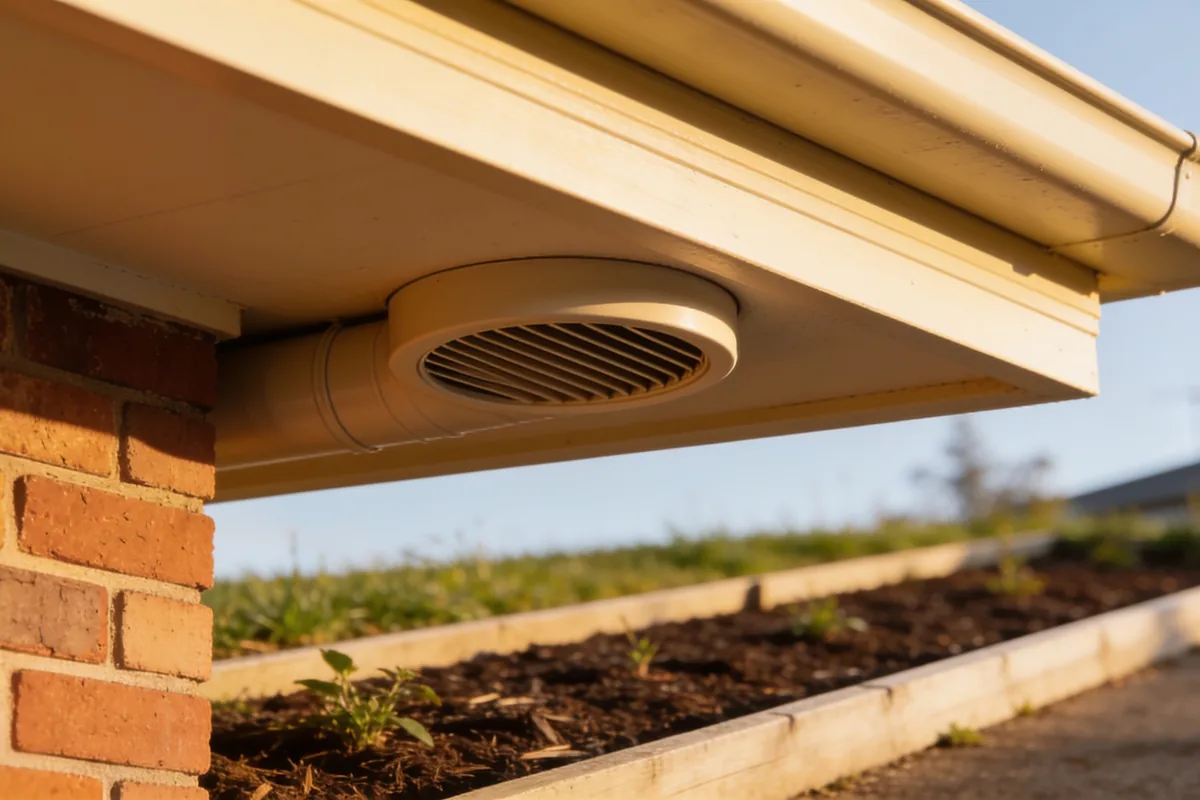
“Ducted” is not “ducted to outside”. A duct can run a metre and stop. The quote should name the destination, and it helps to know what the 2025 housing provisions say in clause 10.8.2. These are that edition’s words, and the 2022 clauses we read match the first three points:
- Flow rate. At least 25 litres a second for a bathroom (40 for a kitchen or laundry).
- Discharge. “Directly or via a shaft or duct to outdoor air”. Name the outlet: eave, wall or roof.
- Clothes dryers. A venting clothes dryer follows the same rule. The clause covers venting dryers, and the explanatory note says condensing ones are not covered.
- Run-on. A fan that does not run continuously and serves a bathroom with no natural ventilation is wired so it comes on with the light and runs for 10 minutes after.
- Make-up air. Air has to get in for air to get out: 14,000 mm² of free area, or an approach under AS 1668.2. The code’s own example is a 20 mm gap under a 700 mm wide door.
You do not need a lecture from the tradesperson. You need one sentence on paper that says where the air goes. The same Victorian notice told surveyors that compliance can usually be checked at final inspection, either by an externally visible discharge point or by the appropriate roof ventilation being installed. An outlet you can see from outside is also one you can photograph on the day, so the sentence on the quote is easy to hold someone to.
Who Fits It
A fan is a fixed electrical appliance, and the wiring is electrician’s work. In Victoria, Energy Safe Victoria’s guidance says to engage a registered electrical contractor for electrical work, never to do your own, and to ask for a Certificate of Electrical Safety. We have not opened the other states’ regulators, so elsewhere, check your state’s regulator for the equivalent.
The duct and the outlet are a different question, and they can fall between trades. The electrician wires the fan. A roofer or builder may be the person who cuts through a soffit or a roof sheet. Ask who is responsible for the duct and the outlet, and have a name beside that line on the quote. If it says “by others”, the discharge point has no owner yet.
To start a shortlist, the directory’s electrician category lists local electrical businesses, and the home improvement category covers the wider trades a ceiling and roof job can touch. The same questions work on any name you find.
“Is the Fan Already in My House Wrong?”
This is the question a homeowner usually asks next, and the honest answer is: not automatically.
The ABCB’s introduction to the code says the NCC “primarily applies to the design and construction of new buildings”, and that it may also apply to “new building work” in existing buildings. It adds that adoption dates are set by the states and territories, and a separate provision says the code is subject to, and may be overridden by, state or territory legislation. Nothing we read says a house built under the 2019 text has to be retrofitted because the text changed. A fan that fed a compliant roof space was lawful under the 2019 edition, if that was the edition the house was approved under.
One view in public discussion is that the code only says “may”, so a fan into the roof is acceptable. It has a fair point: the 2019 edition did allow a ventilated roof space, and a surveyor can accept a Performance Solution. But the deemed-to-satisfy clause now says “must discharge”, and a quote for new work cannot lean on “may”. Another view is that the fix is to duct to the eave or a side wall, and that is a reasonable reading of what the code now asks.
So where does that leave a house that already has a fan into the roof? Not in trouble by default. A renovation that opens the ceiling is the moment to ask, because the duct is exposed and the surveyor is already involved. A renovation specialist can tell you whether your job needs a permit, and the surveyor on that permit is the person to ask about discharge.
Where the Duct Ends
The check is the discharge point. Before the ceiling is cut, put the outlet in writing: eave, wall or roof, who installs it, and a sentence saying the fan discharges to outdoor air. If your job falls under an edition that still allows a ventilated roof space, the surveyor will say so, and then the formula applies, not the word “ducted”.
Sources: Australian Building Codes Board, NCC 2025 Housing Provisions, Part 10.8 Condensation management (https://ncc.abcb.gov.au/editions/ncc-2025/adopted/housing-provisions/10-health-and-amenity/part-108-condensation-management); Australian Building Codes Board, NCC 2022 Housing Provisions, Part 10.8 Condensation management (https://ncc.abcb.gov.au/editions/ncc-2022/adopted/housing-provisions/10-health-and-amenity/part-108-condensation-management); Australian Building Codes Board, NCC 2019 Volume Two, Part 3.8.7 Condensation management (https://ncc.abcb.gov.au/editions/2019/ncc-2019-volume-two/part-38-health-and-amenity/part-387-condensation-management); Australian Building Codes Board, NCC 2025 state and territory adoption information (https://ncc.abcb.gov.au/ncc-2025/ncc-2025-state-and-territory-adoption-information); Australian Building Codes Board, NCC 2022 state and territory adoption dates (https://ncc.abcb.gov.au/ncc-2022-state-and-territory-adoption-dates); Australian Building Codes Board, Introduction to the National Construction Code (https://ncc.abcb.gov.au/editions/ncc-2025/adopted/volume-two/preface/introduction-national-construction-code-ncc); Australian Building Codes Board, NCC 2025 Volume Two, Part A3 Application of the NCC in the states and territories (https://ncc.abcb.gov.au/editions/ncc-2025/adopted/volume-two/a-governing-requirements/part-a3-application-ncc-states-and-territories); Victorian Building Authority, Complaints: Exhaust fan discharge, 9 June 2022 (https://www.vba.vic.gov.au/news/news/2022/complaints-exhaust-fan-discharge1); Energy Safe Victoria, Working with tradespeople (https://www.energysafe.vic.gov.au/community-safety/working-tradespeople)