
A Split System Installation Needs Two Licences, and the Quote Should Show Both Numbers
 Marco Pellegrini
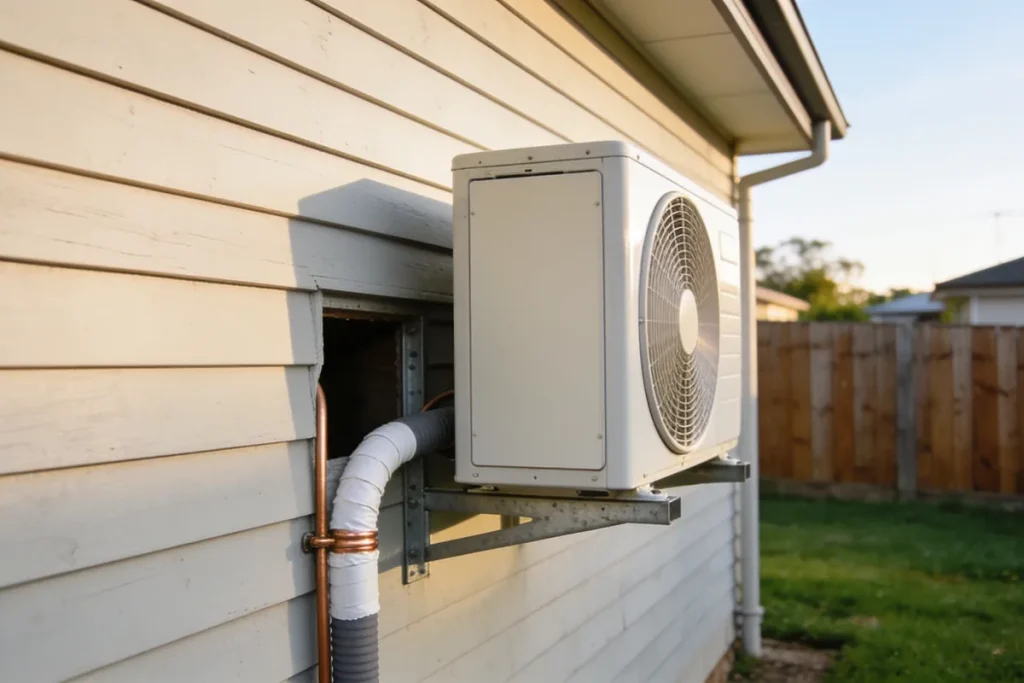
Imagine a quote landing in your inbox on a warm afternoon. One outdoor unit, one indoor unit, a wall bracket, a run of pipe, a date and a total. Near the top, in bold, it says “fully licensed installer”. You read it twice. You look for a licence number on the first page, then in the footer, then in the terms. There isn’t one. Just the words “fully licensed”, carrying all the weight on their own.
That scene is made up, but the gap in it is real. This post is aimed at the informational tail of split system installation: who is actually allowed to do the work, and what should be written down before you pay a deposit.
Our position is simple. Ask for two licence numbers on the quote. One is the national refrigerant handling licence. The other is the licence that covers the wiring in your state, and that one changes depending on where you live. By the end you will know what to ask, how to check each answer, and where the rules are narrower than the guides suggest.
A note on limits. This is general information, not legal or electrical advice. It covers New South Wales, Victoria, Queensland and Western Australia, as the regulators’ pages stood in September 2026. South Australia, Tasmania, the ACT and the Northern Territory are not covered here, so ask your state regulator.
What a Quote Usually Says, and What It Leaves Out
Read enough installer pages and a pattern shows. Hire a licensed installer. Check their registration number with the Australian Refrigeration Council. Do not do it yourself. All of that is sound advice. What it skips is the detail. One installation guide from March 2025 says installation has to be done by both a licensed electrician and an HVAC technician. That sounds firm, but it describes two people, and the regulators’ pages describe something narrower and different from state to state. In New South Wales, the air conditioning and refrigeration contractor licence covers associated electrical work. In Queensland and Western Australia, the restricted electrical licence a refrigeration technician can hold stops short of installing a new circuit, and in Queensland it does not cover installing the interconnect cable either.
So “licensed” is not one thing. It is at least two credentials, and the second depends on your postcode. A quote that prints neither number has not told you which one the installer holds, or whether they hold the one your job needs.
The other side has a fair point. Plenty of installers hold both licences, or work alongside a person who does, and a fixed-price quote from a business like that is not a trick. The aim here is not to doubt anyone. It is to turn “trust me” into something you can look up.
Licence One: Handling the Refrigerant
The first credential is federal and has nothing to do with your state. The Australian Refrigeration Council says handling fluorocarbon refrigerant without a Refrigerant Handling Licence is an offence, and that installing air conditioning equipment falls within what the licence covers.
The council describes several licence types. Two matter for a household split system.
- RAC01 is the full refrigeration and air conditioning licence.
- RSS03 is a restricted licence. Its listed scope includes installing and decommissioning a single-head split system under 18 kW. The same page lists two-part hot water systems and pool heat pumps under 18 kW.
A third class, RDR04, is described as not covering split system air conditioners, so a tradesperson holding only that one is not the person for the job.
Notice what RSS03 says and does not say. It is a single-head licence. The page does not say a multi-head or ducted system needs the full RAC01, and this post will not say so either. If your job is anything but a single head on a wall, ask which class covers it, and ask them to write the class on the quote.
The council’s pages carry no date, and the licence classes have been long-standing, so check the current wording with the council before you rely on it.
How do you check? The council says you can find authorised businesses and licensed technicians through its Look for the Tick website. That is the step most people skip. Asking an installer “are you licensed?” produces a yes nearly every time. Looking the name up produces an answer. The directory’s air conditioning expert listings are a reasonable place to start a shortlist, and the lookup is how you confirm each name on it.
Licence Two: The Wiring, State by State
Here the national picture breaks into four. Each row below says only what the regulator’s page says, with its date where it has one.
| State | The wiring rule, as the page states it |
|---|---|
| NSW | The air conditioning and refrigeration contractor licence is needed “to install, maintain or service an air conditioning or refrigeration systems”, and it “allows you to carry out any associated electrical work”, with examples such as testing circuits, disconnecting and reconnecting components and “minor alterations to electrical wiring”. It “does not cover work on self-contained single phase plug-in domestic air conditioning” units but “does include any three-phase or ducted air-conditioning systems”. (The business licence page is undated and lists 2026-27 fees.) Separately, the NSW Government says you need an electrical licence or certificate “before you can do any electrical wiring work”, with no cost threshold (updated 23 June 2026) |
| Victoria | Energy Safe Victoria “licences and registers all electrical tradespersons”, and its licence is “a requirement to do electrical work in Victoria” (reviewed 19 August 2024). A Certificate of Electrical Safety is “required for all electrical installation work” and issued by the electrician (reviewed 31 July 2026). The page does not say whether a given air conditioner job counts, so ask the electrician whether one will be lodged |
| Queensland | A refrigeration mechanic can do electrical work only with an electrical worker licence or a restricted electrical work licence for refrigeration and air conditioning. The restricted licence “does not permit electrical installation work”, and installing air conditioner interconnect cables is the example given (QBCC, quoting the Electrical Safety Office, reviewed 15 February 2021) |
| Western Australia | The restricted electrical licence for refrigeration and air conditioning is issued with a scope of five items: disconnecting and reconnecting equipment, fault finding power and control circuits, modifying, replacing or repairing within the equipment “package”, modifying control circuits in switchboards and panels, and “Assemble factory supplied cable between R&AC split system components (up to 4kW)” (Electrical Licensing Board policy, meeting of 21 August 2025). The list has no new circuit and no fixed wiring |
Read the table slowly, because the rows do not say the same thing.
In New South Wales, the refrigeration contractor licence covers the electrical work associated with the unit. The page’s own examples are testing circuits, disconnecting and reconnecting components, replacing components on the load side of the mains, repairs and “minor alterations to electrical wiring”. It does not list installing a new circuit, and the separate rule that you need an electrical licence or certificate for any electrical wiring work still stands, so for a new circuit ask who holds that licence.
In Queensland and Western Australia the pattern flips, though not identically. In Queensland the restricted licence “does not permit electrical installation work”, and the example the page gives is installing air conditioner interconnect cables. In Western Australia the Board’s list reaches factory-supplied cable between the split system components, up to 4kW, but the list has no new circuit and no fixed wiring. In both, a new circuit is an electrician’s work.
Victoria’s page is about electrical licensing in general. It does not list refrigeration classes, and it does not mention air conditioners, so this post stops at what it says. An electrician licensed by Energy Safe Victoria does the electrical work, and a certificate records it. Whether your particular job needs one, the electrician can answer.
Put the four rows side by side and the guide’s electrician and HVAC technician starts to look flat. In one state the refrigeration contractor’s licence reaches some of the electrical work, though not obviously a new circuit. In two others it is plainly two credentials. In the fourth, ask.
Which Job Needs What
The rules bite differently on different jobs, so here is a second table, built only from the facts above and from a consumer-advice installation guide (last updated 28 April 2023).
| Job | Refrigerant licence | Wiring |
|---|---|---|
| First install of a split, on a new circuit | Yes. RSS03 covers a single head under 18 kW | The state’s electrical authority. A new circuit is installation work, and the guide says “some electrical work will be needed” |
| Like-for-like swap | Yes | The guide says it “shouldn’t require any new electrical work in most cases”. Ask who disconnects and reconnects the supply |
| Multi-head or ducted | Ask which class covers it. RSS03 is described as single-head only | The state rule above. The NSW contractor licence “does include any three-phase or ducted” systems |
| Plug-in portable | Not an installation | NSW’s air conditioning licence excludes “self-contained single phase plug-in” units, and there is no wiring job |
Two more points from the same guide. It mentions a dedicated circuit for the unit, which is why some households book the electrician first and the refrigeration technician second. And it says plumbing accreditation “may be needed” where the condensate drain connects to waste water, so a third trade can enter the picture on some jobs.
This is also why the community posts you may have seen read the way they do. People ask who is allowed to do which part. Some have the power point and the hole in the wall done by an electrician first, then go looking for someone to fit the unit. That is a sensible order, but it only works if the second person holds the right refrigerant licence. If you want an electrician for that step, the directory’s electrician listings are organised by category, and the same lookup logic applies to a wiring licence.
For a like-for-like swap, a plug-in portable, or a job where the electrical work is already done, the second licence may not come into play at all. The refrigerant licence almost always does, as long as the job is an install.
What the Quote and the Paperwork Should Show
A quote that holds up under a second read has these lines on it:
- The refrigerant licence number, and the class if it is RSS03. A restricted class covers single-head units only, so the quote should say the unit is a single head.
- The wiring licence number for your state, and who holds it. This may be the installer, or a separate electrician.
- Who does the electrical work and who certifies it. If the installer is subcontracting the wiring, the quote should say to whom.
- A copy of the electrical certificate after the work, in the states where one applies. In Victoria that is the Certificate of Electrical Safety, which the electrician issues. Ask whether one will be lodged.
- A note on the warranty condition. The consumer-advice guide says licence requirements are linked to the product warranty not being voided. The page does not say what any maker requires, so read your own warranty terms and ask the installer to confirm in writing that the install meets them.
You do not need to know what a licence number looks like to check it. What you need is the number written down, the name it belongs to, and a lookup result that matches. If a business would rather not put a number on paper, that is useful to know before the deposit, not after.
If the Installer Was Not Licensed
Take a hypothetical household. The unit is up, the room is cool, and a week later a friend asks who did the install. The household does not know whether the installer held a refrigerant licence. What now?
Three things, in plain terms, none of them legal advice.
First, the refrigerant regime. The Australian Refrigeration Council says handling fluorocarbon refrigerant without a Refrigerant Handling Licence is an offence. That is a matter between the installer and the regulator, and this post does not name a penalty because the pages it opened do not support one for September 2026.
Second, your consumer rights. The ACCC says service providers must carry out all services using an acceptable level of care and skill, and that the remedies for a failure include repair, refund, cancellation or compensation. That guarantee applies to services regardless of the licence question, so a poorly done install is a problem whether or not the installer held a number.
Third, the warranty. The consumer-advice guide links the licence requirement to the product warranty not being voided. What your maker requires is a question for your own warranty paperwork, not for this post.
If the paperwork is missing, start with a polite written request to the installer. Keep the quote, the invoice and any messages together, because they show what was agreed. If the answer does not satisfy you, your state regulator is the next call.
Two Numbers Before the Deposit
Ask the installer for the refrigerant licence number and the wiring licence number that covers your job. Look each one up, using the Look for the Tick site for the first and your state regulator for the second. Write both on the quote before any money moves. After that, the quote says what it should have said from the start.
Sources: Australian Refrigeration Council, Licence types (https://www.arctick.org/licensing/licence-types/); Australian Refrigeration Council, Licensing (https://www.arctick.org/licensing/); Australian Refrigeration Council, How do I check if someone is licensed (https://www.arctick.org/information/report-a-breach-relating-to-regulated-refrigerants/how-do-i-check-if-someone-is-licensed/); ABLIS, Contractor Licence Air-Conditioning and Refrigeration Individual New South Wales (https://ablis.business.gov.au/NSW/pages/1260534c-6d0a-4033-bda1-c5f1ddc1bf6e.aspx); NSW Government, Electrical licences (https://www.nsw.gov.au/business-and-economy/licences-and-credentials/building-and-trade-licences-and-registrations/electrical); Energy Safe Victoria, Electrical licences (https://www.energysafe.vic.gov.au/licensing/electrical-licences); Energy Safe Victoria, About Certificates of Electrical Safety (https://www.energysafe.vic.gov.au/certificates-electrical-safety/about-certificates-electrical-safety); QBCC, Refrigeration and air-conditioning technicians and electrical work (https://qbcc.qld.gov.au/resources/article/refrigeration-air-conditioning-technicians-electrical-work); Electrical Licensing Board WA, Training requirements for the issue of a restricted electrical licence for refrigeration and air-conditioning equipment (https://www.wa.gov.au/media/155240/download); Consumer-advice guide, How much does an air conditioner cost to install or replace (https://www.choice.com.au/home-and-living/cooling/air-conditioners/buying-guides/air-conditioner-installation); ACCC, Consumer rights and guarantees (https://www.accc.gov.au/consumers/buying-products-and-services/consumer-rights-and-guarantees)