
The Barbecue Is the Smallest Legal Part of an Outdoor Kitchen
- Home Services
-
Sep 22
- Share post
 Fiona Delaney
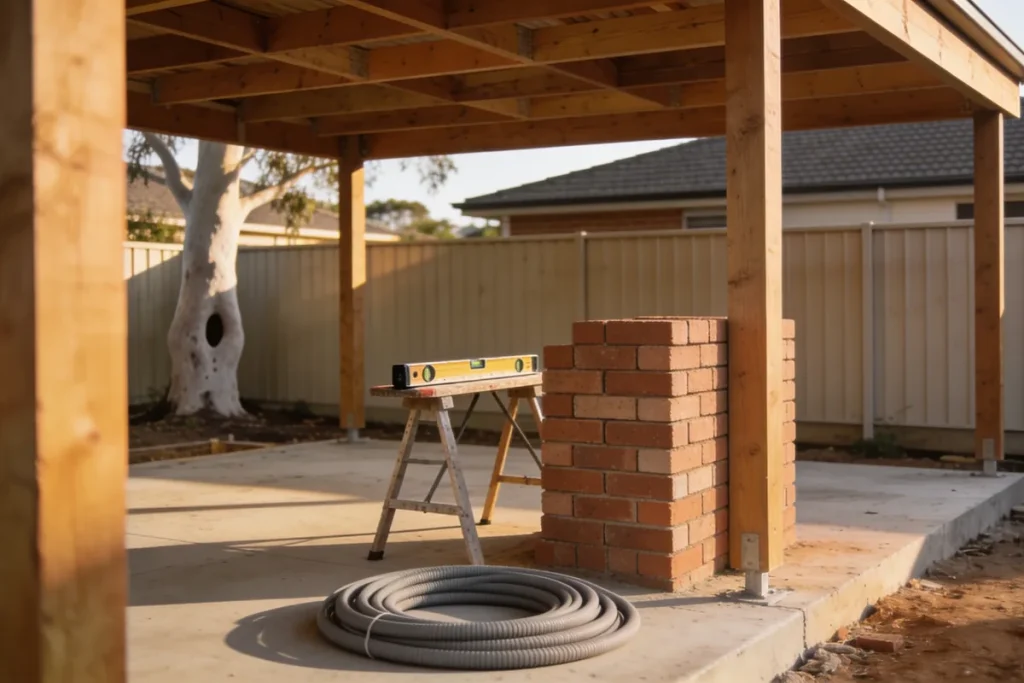
If you have a freestanding barbecue on a gas bottle, you can relax a little. Most of what follows is about something bigger, and the freestanding kind sits at the quiet end of it. New South Wales, for one, defines gasfitting so that it leaves out “readily detachable” connections and cylinder changeovers, which is the sort of thing a bottle-fed barbecue involves. Rules differ by state, so check yours, but you are not the reader this post worries about.
The reader it worries about is the one planning an outdoor kitchen. A built-in bench, a sink, a fridge, a roof over the lot. It is late September, daylight saving starts on 4 October, and the idea of cooking outside until dark is very easy to say yes to.
Here is the catch, and it is a gentle one. Each of those parts belongs to a different trade. The gas goes to a gas fitter, the power to an electrician, the sink to a plumber, and the roof to your council or a certifier. The barbecue itself is the least regulated thing on the list.
Our position is simple. Before you price the bench, ask each trade for its own certificate, and ask your council whether the roofed structure needs a permit. None of these is a hard conversation. They only need to happen before the bench is priced, not after.
Which Trade Does Which Part
The table below is the short version of what the regulator pages say. A word on limits first: this is general information, not advice, and it covers New South Wales, Queensland and Western Australia, with some of Victoria. South Australia, Tasmania, the ACT and the Northern Territory are not covered here, so ask your state regulator.
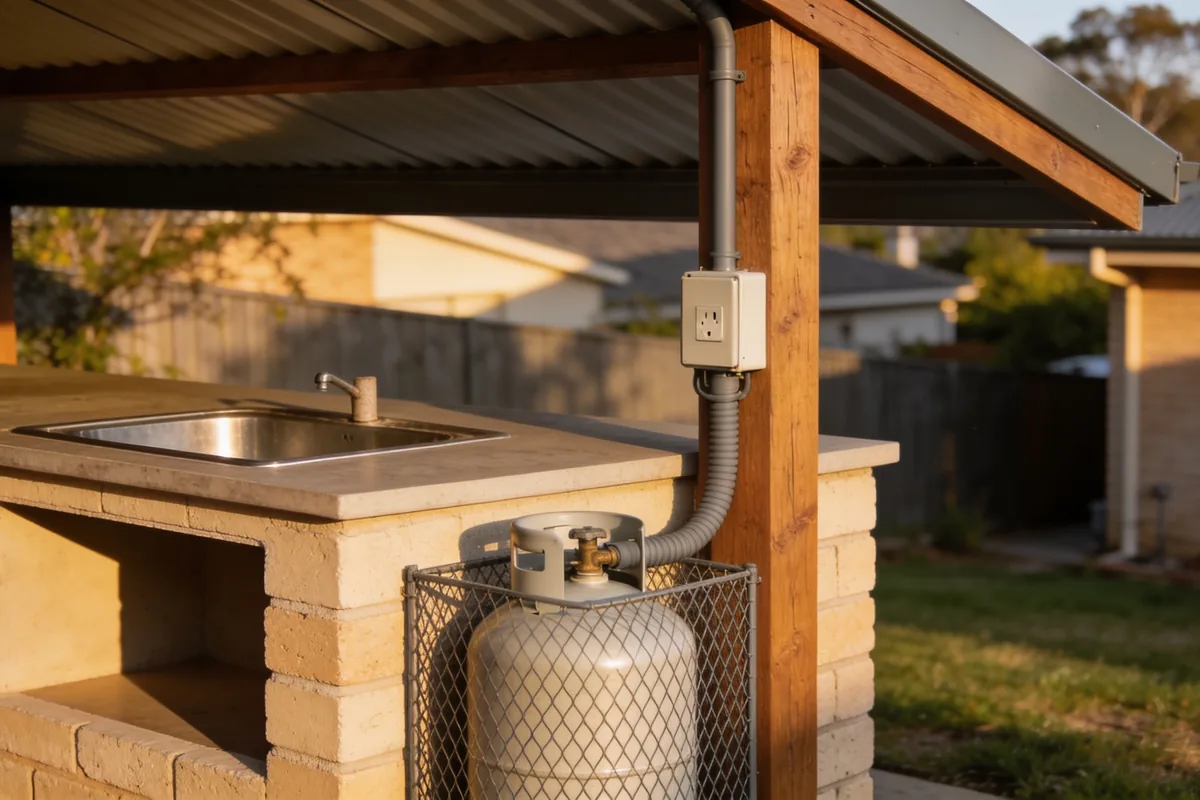
| Part | Who | What the page says |
|---|---|---|
| Gas, fixed connection | Licensed gas fitter | NSW: gasfitting includes connecting or disconnecting a gas appliance, regulator or container, other than where it is designed to be readily detachable (NSW Government, updated 31 July 2026). WA: gasfitting is done by a licence holder, with the licence issued by Building and Energy (last updated 30 May 2025). Queensland: gasfitting licences are issued by the Chief Gas Examiner and Resources Safety and Health Queensland (QBCC, reviewed 5 January 2024). Victoria: the Building and Plumbing Commission licenses gasfitters (Energy Safe Victoria, reviewed 18 August 2025) |
| Gas paperwork | The gas fitter | NSW: a certificate of compliance for work on an installation “connected to a gas network”, a certificate of inspection where it is not (updated 9 April 2026). WA: a Notice of Completion |
| Power | Licensed electrician | NSW: an electrical licence or certificate “before you can do any electrical wiring work”, with no cost threshold (updated 23 June 2026). Victoria: a licence from Energy Safe Victoria, and a Certificate of Electrical Safety “required for all electrical installation work” (pages reviewed 19 August 2024 and 31 July 2026) |
| Sink and water | Licensed plumber | NSW: a licence for water plumbing (updated 31 July 2026). Queensland: installing new or relocating fixtures such as “kitchen sinks” is notifiable work in existing homes, which the plumber registers within 10 business days of issuing an invoice, with a copy to the owner; work for new construction is permit work instead (QBCC, reviewed 14 February 2024) |
| Roof and bench structure | Council or certifier | See “The Roof and the Permit” below |
Notice that nobody on that list is the barbecue maker. The appliance is the thing you choose. The trades are the people who connect it to the world.
Gas: The Fitter and the Paper
Gas is the part most worth getting right, and the rules are clearer than you might expect.
In New South Wales, the Government’s page says a licence is needed for plumbing, draining or gasfitting “regardless of the cost”. Gasfitting there includes connecting or disconnecting gas appliances and containers, other than readily detachable connections. The same state’s gasfitter page says a certificate of compliance applies to work on an installation connected to a gas network, and a certificate of inspection where it is not. It excludes cylinder changeovers and readily detachable connections as well. The NSW page also sets fines of up to $22,000 for an individual and $110,000 for a company for unlicensed work, which is a good reason to ask for the licence number rather than take a mate’s word.
In Western Australia, Building and Energy says gasfitting is done by a licence holder, and that a Notice of Completion goes to the owner and the gas supplier within 48 hours. If you have asked a fitter to connect a built-in barbecue there, you can reasonably expect that notice.
In Queensland, gasfitting licences are issued by the Chief Gas Examiner and Resources Safety and Health Queensland, and QBCC says a QBCC contractor licence alone is not enough for gasfitting. Which certificate follows the work is not something this post could pin down, so ask your fitter what they lodge.
In Victoria, the Building and Plumbing Commission is responsible for licensing gasfitters, according to Energy Safe Victoria. The page says nothing about certificates, so the same question applies: ask what you will receive.
Whatever the state, a good fitter will tell you the licence number, what they are connecting, and what paperwork you will get afterwards. If you are still collecting names, the directory’s plumber listings are a place to start, and the licence check is yours to make.
Power: The Electrician
The fridge, the lights and the power point on the post all need a licensed electrician, and the pages are consistent about that.
New South Wales says you need an electrical licence or certificate before you can do any electrical wiring work, with no minimum job size. In Victoria, Energy Safe Victoria licenses electricians, its licence is a requirement for electrical work in the state, and a Certificate of Electrical Safety is required for all electrical installation work. The certificate is a record issued by the electrician, so ask for a copy when the job is done.
For the other states, this post has not pinned the wording, so ask your regulator. A quick call settles it, and it is not worth guessing. The directory’s electrician listings are there for the shortlist.
The Sink: The Plumber
A sink in an outdoor bench is a plumbing job, even when it looks like a small one.
In New South Wales, the Government’s page says water plumbing needs a licence. In Queensland, QBCC lists installing new or relocating fixtures such as “kitchen sinks” as notifiable work in existing homes: the plumber registers it within 10 business days of issuing an invoice and gives the owner a copy of the form. New construction is permit work instead, so ask which applies to your site. That copy is worth keeping with the rest of the paperwork for the project.
If the idea of a plumber’s certificate is new to you, the directory’s guide to paperwork after a hot water replacement looks at what a plumber hands over at the end of a different job. The detail differs, the habit is the same: finish the work, then hand over the paper.
The Roof and the Permit
This is the part that surprises people, because a bench with a roof on it starts to look like a small building. Whether it needs a permit depends on the state and on what the roof is.
Western Australia. Schedule 4 of the Building Regulations 2012 lists building work that is exempt from a permit. A freestanding Class 10a structure is on it up to 10 square metres and 2.4 metres high, provided it is not in wind region C or D. A pergola associated with a Class 1 building is also listed, up to 2.4 metres high and 20 square metres, again outside wind regions C and D. The Regulations define a pergola as “an open structure that does not have a roof but may have a covering of open weave permeable material”, so a bench with a solid roof does not fit the pergola item. The freestanding Class 10a item is the one that could apply, and only if the structure stands on its own, is no larger than 10 square metres, is no higher than 2.4 metres and sits outside wind regions C and D. Whether your bench meets that is a question for your local government.
Brisbane. Brisbane City Council’s page says a deck is exempt only if it is unroofed. In other words, a roofed deck needs building approval. The page does not mention patios, pergolas or barbecues, so treat it as a clear signal rather than a ruling on your bench, and ask the council about your plan.
New South Wales. The Department of Planning’s fact sheet on gazebos and similar structures says they are exempt only if they meet clauses 2.17 and 2.18 of the Codes SEPP. The fact sheet does not print those standards, so this post cannot tell you the numbers. If your structure is exempt, no certifier is needed, but tree work and stormwater connections still need council approval.
Victoria. This post could not confirm the state’s rules for structures like this, so it says nothing about them. Ask your council.
A point about ventilation. The roof is also a gas question. Building and Energy WA publishes when a roofed or walled outdoor area counts as naturally ventilated for a barbecue. Four open sides with a roof or overhead cover is one combination that counts. Two parallel walls, or two walls at right angles, with a roof is another. The regulator’s guidance says outdoor-rated barbecues are only to be used outdoors in a well-ventilated area, and it warns that semi-outdoor spaces may not have enough ventilation. Balconies and verandas have their own opening requirement as well.
That is a Western Australian rule, and this post is not saying it applies elsewhere. Other states may have their own, so ask. The point is that a barbecue under a roof is a gas question as well as a permit question.
If the roof is the part you need help with, the directory’s outdoor structures listings are a starting point for builders who work on covered areas, and the permit question still goes to your council.
What to Ask Each Trade, and the Council
Here is a short list you can read out over the phone or keep on your fridge.
- Licence number and class. The gas fitter, the electrician and the plumber each have their own.
- The certificate afterwards. What will it be called, and when will you get it?
- Who lodges it. Some are lodged by the tradie, and the owner gets a copy.
- Does the roofed bench need approval? Put your actual plan to the council, not a general description.
- Ventilation under the roof. If a barbecue is going under it, ask whether your layout is considered well ventilated.
A fair counterpoint: some bench-and-roof projects are exempt, and a freestanding barbecue on a bottle is outside most of this. You may find that your plan needs fewer phone calls than you feared. That is a good outcome, and the only way to reach it is to ask.
Trades First, Bench Second
Pick the barbecue last. Before you spend anything on the bench, ask the gas fitter, the electrician and the plumber for their licence numbers and their paperwork, and ask your council about the roof. The barbecue is the smallest legal part of an outdoor kitchen, and the people who connect it are the ones who make it safe to switch on.
Sources: NSW Government, Plumbing, draining and gasfitting (https://www.nsw.gov.au/business-and-economy/licences-and-credentials/building-and-trade-licences-and-registrations/plumbing-draining-and-gasfitting); NSW Government, Gasfitter compliance and regulatory obligations (https://www.nsw.gov.au/housing-and-construction/compliance-and-regulation/gasfitters/gasfitter-compliance-and-regulatory-obligations); NSW Government, Electrical (https://www.nsw.gov.au/business-and-economy/licences-and-credentials/building-and-trade-licences-and-registrations/electrical); Building and Energy WA, Gas safety at home (https://www.wa.gov.au/organisation/building-and-energy/gas-safety-home); Department of Local Government, Industry Regulation and Safety WA, Safe locations for using gas barbecues and gas patio heaters (https://www.wa.gov.au/media/58370/download?inline); QBCC, Which licence type you need (https://qbcc.qld.gov.au/licences/start-your-career/which-licence-type-you-need); QBCC, What is notifiable work (https://qbcc.qld.gov.au/worksite-building-practice/plumbing-work/what-notifiable-work); Energy Safe Victoria, Gasfitter licences (https://www.energysafe.vic.gov.au/licensing/gasfitter-licences); Energy Safe Victoria, About Certificates of Electrical Safety (https://www.energysafe.vic.gov.au/certificates-electrical-safety/about-certificates-electrical-safety); Building Regulations 2012 (WA), Schedule 4 (https://www.legislation.wa.gov.au/legislation/prod/filestore.nsf/FileURL/mrdoc_49883.htm/$FILE/Building%20Regulations%202012%20-%20%5B04-af0-00%5D.html?OpenElement); Brisbane City Council, Deck (https://www.brisbane.qld.gov.au/building-and-planning/getting-started-on-your-project/residential-projects/deck); NSW Department of Planning and Environment, Cabanas, cubby houses, ferneries, garden sheds, gazebos and greenhouses: rules for exempt development (https://www.planning.nsw.gov.au/sites/default/files/2023-02/cabanas-cubby-houses-ferneries-garden-sheds-gazebos-and-greenhouses-rules-for-exempt-development.pdf)