
Before You Sign a Bathroom Renovation Quote, Find the Waterproofing Line
 Marco Pellegrini
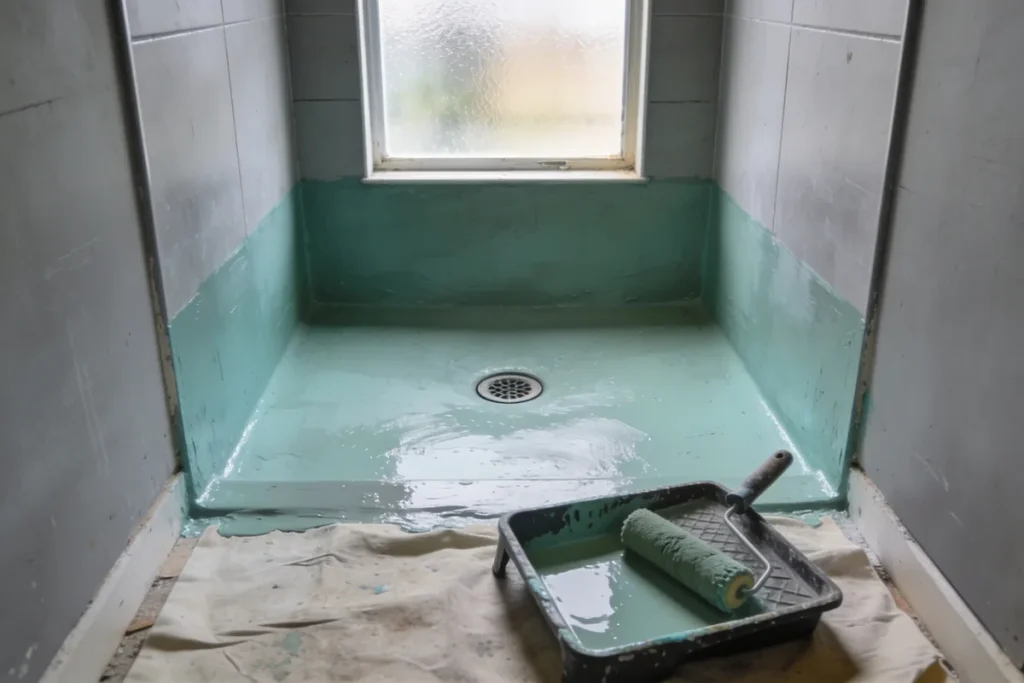
Two quotes sit on the kitchen table, held flat by a mug of coffee that went cold an hour ago. They are for the same bathroom, a two by three metre room in a house that has seen a few decades of hot showers, and the totals are thousands of dollars apart. Most of the lines are easy to hold up against each other. One quote names a tile, the other names a different tile at a different price. One includes the vanity, the other expects you to choose and buy your own. You could walk into a showroom on Port Road and hold every one of those things in your hands.
The membrane is another matter. It goes on after the old room has been stripped back to the sheeting and the slab, and before the first tile is laid, and once the tiler packs up nobody sees it again unless something has gone wrong. On a lot of bathroom renovation quotes it is also the line with the fewest words. It deserves the slowest reading.
What waterproofing covers in a bathroom
Before you can judge a quote, it helps to know what the job is supposed to be. In Australia that is set out in the National Construction Code. Part 10.2 of the NCC 2022 Housing Provisions deals with wet area waterproofing, and it uses two words that sound alike but mean different grades of protection: waterproof and water resistant. Waterproof is the stronger requirement. A quote, or a tradesperson, that uses the two as if they were the same is worth a second question.
Inside the shower, clause 10.2.2 asks for the most. The shower floor must be waterproof, including any hob or step-down. The shower walls must be waterproof to not less than 1800 mm above the floor substrate. Where two walls meet inside the shower, the junction must be waterproof for 40 mm either side. The junctions between wall and floor, and the penetrations where pipes and fittings come through, must be waterproof too.
Outside the shower, under clause 10.2.3, the answer depends on what the floor is made of. A concrete or fibre-cement floor must be water resistant. A timber, particleboard or plywood floor must be waterproof, which is the stricter grade, and older homes with timber floors in the bathroom are exactly where that difference shows up on a quote.
Around a bath, clause 10.2.4 applies. Where the bath sits within 75 mm of a wall, that wall must be water resistant to 150 mm above the bath.
| Area | What Part 10.2 asks for |
|---|---|
| Shower floor, including any hob or step-down | Waterproof |
| Shower walls | Waterproof to not less than 1800 mm above the floor substrate |
| Wall junctions inside the shower | Waterproof, 40 mm either side |
| Wall and floor junctions, penetrations | Waterproof |
| Floor outside the shower, concrete or fibre-cement | Water resistant |
| Floor outside the shower, timber, particleboard or plywood | Waterproof |
| Walls beside a bath within 75 mm of the wall | Water resistant to 150 mm above the bath |
These provisions are one way to comply. The other is the Australian Standard for wet areas, AS 3740:2021, which a waterproofer may tell you they work to instead. Either route is legitimate, as long as the quote tells you which one the waterproofer is following.
The line on the quote
I spent eight years writing about small businesses and the way their owners put things on paper, and the paperwork that held up later was nearly always the specific kind. A waterproofing line that will hold up later names six things.
Who applies the membrane. It might be the tiler, a separate waterproofer, or the builder running the job. On a renovation with several trades coming through, this is the question that most often goes unanswered, and it matters, because the person who applies the membrane is the person responsible for it. If the tiler is doing it, ask. If someone else is, ask for their name. The directory lists waterproofers separately for that reason.
The product or system. A brand and product name, or at least the type of membrane. You do not need to be an expert in membranes to write it down and look it up later.
Which areas. The whole floor, or only the shower? To what height on the shower walls, and on the walls outside it? Set it against the table above. A line that says “shower waterproofed” may be describing less than your floor requires.
The substrate preparation. What the membrane goes onto matters as much as the membrane. Ask what is done to the floor and walls before it goes on.
A flood test or inspection. Ask whether the membrane is tested or inspected before the tiler covers it, and whether you can see it at that stage.
The paperwork at the end. What will you be handed when the job is done?
If the line on your quote reads only “waterproofing”, with no detail at all, ask for the detail in writing before you sign. A tradesperson who knows the job should be able to fill it in without much fuss.
Licences: who is allowed to do it
A whole bathroom renovation will usually cross the licensing thresholds in most states, and waterproofing is named in the rules in its own right. The thresholds differ.
New South Wales. The NSW Government states that a contractor licence is needed for residential building or trade work, including waterproofing, where the labour and materials are worth more than $5,000 including GST. The licence can be checked online through the NSW licence check before you sign.
Queensland. The QBCC requires a licence for building work valued at more than $3,300. When the waterproofing is done by a separate trade, ask whether that person holds the waterproofing licence class.
Victoria. Consumer Affairs Victoria explains that builders must be registered for domestic building contracts worth more than $10,000. Registration sits with the Building and Plumbing Commission, and there is a builder class limited to waterproofing.
South Australia, where I live, and the other states and territories set their own rules, so readers there should check with their state regulator. In every state, the useful habit is the same: ask for the licence or registration number, see that it is written on the quote, and look it up yourself.
The certificate, and why to keep it
Plenty of people ask whether their bathroom needs a “waterproofing certificate”. The paperwork, and who is required to issue it, varies, and I cannot point you to one national rule that settles it.
What you can do is ask. Who will issue a certificate or written statement at the end of the job? What will it say? A useful document names the areas that were waterproofed, the product or system used, and the installer’s licence or registration. Then keep it with your contract, in the folder where the house papers live.
The reason is simple and a bit sobering. A failed membrane does not announce itself. It shows up slowly, in a damp patch on the hallway side of the wall, a skirting board swelling in the next room, a tile that sounds hollow. By the time anyone can see the membrane again, the tiles are coming up. At that point the paperwork is what any claim against the work rests on, and a quote that named the installer, the product and the areas is worth more than any guess about what was done.
Contract and deposit
The waterproofing line sits inside a contract, and in New South Wales the rules on that contract are clear. Residential building work worth more than $5,000 needs a written contract. The deposit can be no more than 10 per cent. For contracts over $20,000, the builder must give you a Home Building Compensation certificate before asking for any deposit, and you have a cooling-off period of five clear business days. A bathroom renovation of any size can sit above both lines, so check which ones apply to yours.
Older homes bring one more question. Asbestos may sit behind old wall sheeting or under floor tiles in bathrooms that have not been touched for decades, and demolition is the stage that disturbs it. Ask whether the quote includes testing before the room is stripped. The site’s guide to asbestos removal and what has to be licensed explains where the line sits.
Two quotes, one room
Back to the kitchen table. Put Quote A on the left and Quote B on the right, and take a pencil to them one line at a time.
Demolition. Quote A says the room is stripped back to the frame and the slab. Quote B says “remove existing”. Ask B whether that includes the floor tiles and the old screed.
Rubbish. A includes a skip and removal. B is silent, so ask whether that means it costs extra.
Plumbing. Both include rough-in and fit-off. A names a licensed plumber; B does not. Ask.
Electrical. A includes new power to the vanity and an exhaust fan. B mentions neither.
Waterproofing. This is where the gap opens. A names a separate waterproofer, the membrane system, the whole floor and the wall heights, and a statement at the end. B has one word: “waterproofing”.
Tiling. Both include floor and walls, and both name the tile.
Fit-out, and who supplies the fixtures. A supplies the vanity, toilet and tapware. B expects you to buy them and have them on site.
Lay it out like that and the cheaper quote starts to look like a smaller job. It may still be a fair one. You cannot tell until B fills in the lines it left blank, and the waterproofing line is the one to start with. For a whole-room job managed by one business, the directory’s renovation listings are a reasonable place to collect a third quote to set beside the first two.
The Line Under the Tiles
Everything you will see in a finished bathroom is chosen in a showroom. The thing that decides whether it stays dry is chosen on paper. Before you sign, find the waterproofing line and make it say who, what, where and how it is checked. Look up the licence or registration in your own state. Ask what document you will be handed at the end, and file it with the contract. You will look at the tiles every morning for years, but the membrane underneath them is what you are really paying to trust.
Sources: ABCB, National Construction Code 2022 Housing Provisions Part 10.2 Wet area waterproofing (https://ncc.abcb.gov.au/editions/ncc-2022/adopted/housing-provisions/10-health-and-amenity/part-102-wet-area-waterproofing); NSW Government, Waterproofing work, 2026 (https://www.nsw.gov.au/business-and-economy/licences-and-credentials/building-and-trade-licences-and-registrations/waterproofing-work); NSW Government, Contracts for residential building work, 2026 (https://www.nsw.gov.au/housing-and-construction/building-or-renovating-a-home/preparing/contracts)
Landscaper Quotes: How to Compare Them Line by Line
23 October 2026 at 8:37 pm[…] period of five clear business days. These are the same deposit and contract rules that apply to a bathroom renovation, which is a useful comparison for anyone who has been through […]