
Pool Fence Inspections: The Certificate Your State Asks For, and Who Can Issue It
 Hamish Ogilvie
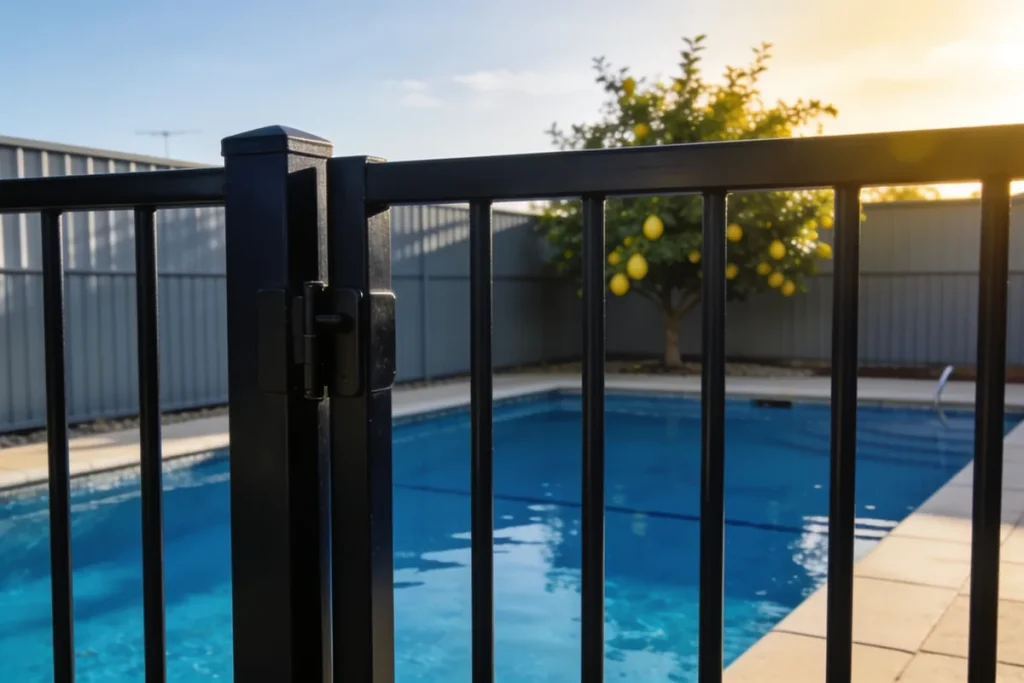
The listing photos are ready, and the one that will sell the house is the pool: blue water, a paved surround, a lemon tree in the corner. Then the agent asks a question the owner has not thought about in years. Where is the pool certificate? The same question arrives in a different form when a property is leased, and in some states it arrives on a schedule whether the house is changing hands or not. The answer depends on the state, and within each state on three things: what triggers the paperwork, how long the paperwork lasts, and who is allowed to sign it. This article sets those out for New South Wales, Queensland, Victoria and Western Australia, then lists the points where a barrier most often fails. The checklist below covers the same fail points, for walking the fence before anyone is booked.
Pool barrier pre-inspection checks
0 of 13Walk the barrier before you book. These are the usual fail points. Your inspector applies the standard that applies to your pool.
The gate
The fence line
The house side
Paperwork and the rest
A checklist, not a certificate. Only a registered or licensed inspector can certify a barrier.
Why the paperwork exists
Every barrier rule in this article has the same purpose: keeping young children out of the water when no adult is watching. The rules apply to more than in-ground pools. In Victoria, the barrier requirements cover pools and spas capable of holding more than 30cm of water, and Western Australia uses the same depth. That brings in spas, above-ground pools and some inflatable pools, which owners often do not think of as pools at all.
The regimes differ in their detail, but each one turns on the same three questions, and it helps to read them in that order. First, the trigger: what event requires a certificate. Second, the term: how long a certificate remains valid. Third, the signatory: who may issue it. A quote from an inspector, or a statement from an agent, should be checked against all three.
A fourth question sits underneath them: whose obligation it is. In some regimes it stays with the owner throughout. In others it can pass from the seller to the buyer at settlement, with a deadline attached. The state sections below note where that happens.
New South Wales
In NSW, the starting point is registration. A pool must be on the NSW Swimming Pools Register, and the register is also where the dates on existing certificates can be checked.
Selling. A contract for the sale of a property with a pool must have one of three documents attached. The first is a certificate of compliance. The second is an occupation certificate together with evidence that the pool is registered. The third is a certificate of non-compliance. Where the seller attaches a certificate of non-compliance, the barrier does not have to be fixed before the sale, but responsibility moves: the buyer has 90 days after settlement to bring it into compliance.
Leasing. A landlord must have the pool registered and give the tenant either a certificate of compliance or an occupation certificate.
Strata and community schemes. Properties in strata or community schemes with more than two lots are exempt from these sale and lease requirements. The exemption is about the sale and lease rules; it is not a statement that the barrier does not matter.
Who issues it. Certificates come from the local council or from an accredited certifier. They are time-limited, so a certificate that existed when the house was bought may not be current when it is sold. Check the date on the register rather than relying on memory or on a document in a drawer.
The NSW structure has one feature worth noting for a seller. The certificate of non-compliance is a legitimate option, but it transfers a job and a deadline to the buyer, and buyers and their advisers can be expected to price that in.
Queensland
The Queensland regime is set out by the QBCC, and its terms are specific.
The trigger. A pool safety certificate is needed to sell or lease a property with a pool, unless a current certificate already exists.
The term. A certificate is valid for 2 years for a non-shared pool and 1 year for a shared pool, such as one in a unit complex. The shorter term for shared pools means body corporates and their managers deal with it more often than house owners do.
The signatory. Certificates are issued by a licensed pool safety inspector. The QBCC licence search can be used to confirm that an inspector holds a current licence before they are engaged.
Selling without a certificate. A seller who does not have a current certificate can still sell, but must give a Form 36 before settlement. The buyer then has to obtain a pool safety certificate within 90 days after settlement. As in NSW, the obligation does not disappear; it changes hands.
Leasing without a certificate. Here the rule is firmer. A lessor must not enter into an accommodation agreement without a current certificate. For a landlord, that means the inspection belongs before the property is advertised, not after a tenant has been found.
Victoria
Victoria runs a cycle that applies whether or not the property is being sold or leased. The Victorian Building Authority sets out the steps.
Registration. Pools and spas must be registered with the local council.
Who may inspect. A registered building surveyor, building inspector or pool inspector, or the municipal building surveyor, may inspect a barrier and issue a certificate.
Lodging. Once a certificate of barrier compliance is issued, the owner must lodge it with council within 30 days of issue. Lodging late is an offence, so the 30 days is the date to diarise, not the inspection date.
The term. The next certificate is due four years later. Victoria is therefore a recurring obligation, and an owner who bought a house with a compliant pool should expect the question to return.
Non-compliance. Where a barrier does not comply, the inspector may issue a certificate of non-compliance, or may issue a notice giving the owner up to 60 days to fix the problem. “Up to” matters: the period stated in the notice is the one that applies, and it may be shorter.
Western Australia
Western Australia places the inspection obligation on local government. Local governments must inspect private pool barriers at least once every four years. For an owner, that means the inspection is likely to be initiated by the council rather than by a sale or lease, and the practical task is to have the barrier in order before the council arrives.
The preparation is the same as anywhere else. Know where the previous inspection paperwork is, walk the barrier with the checklist, and deal with the gate and any climbable objects before the date. An inspection that finds faults is not the end of the matter, but it does start a process with its own timetable, and a latch is cheaper and calmer to fix on the owner’s timetable than on the council’s.
South Australia, Tasmania, the ACT and the Northern Territory each have their own rules. Owners there should check with their council or state regulator.
Who you hire, and when
Three different businesses come into a pool barrier job, and each has a different role. Hiring the right one first saves money and time.
The inspector assesses the barrier and issues the certificate, or the list of faults. The inspector is the only one of the three whose signature counts for compliance, and depending on the state that may be a council officer, an accredited certifier, a licensed pool safety inspector or a registered building surveyor or inspector.
The fencer builds or repairs the barrier. The directory’s fencing and gates listings cover the businesses that fix what an inspection finds, from a gate that will not latch to a run of panels that needs replacing.
The pool builder or servicer looks after the pool itself and sometimes the barrier around it. The pool and spa listings include both builders and the businesses that service an existing pool.
The order matters. An owner who is selling should consider a pre-inspection well before the property is listed, so that any faults can be fixed without a settlement date pressing on the work. Some certifiers will go over the barrier with the owner before the final inspection, and that is the value of the exercise: the faults are found while there is still time to fix them properly, and the fencer is quoting against a known list rather than a guess.
Three points of practice make the process more predictable.
Ask which standard applies. The barrier standard that applies to a pool can depend on when the pool was built or the barrier was installed. Ask the inspector which standard they will apply to this pool, because two people reading the same fence against different assumptions can reach different conclusions. The fencer who built the barrier and the inspector who signs it off do not always read it the same way, and only one of those readings decides the certificate. The safest course is to ask the authority or inspector who will sign it off what they expect, before any work is done.
Get the fault list in writing. A verbal summary at the gate is not something a fencer can quote against. A written list, item by item, is.
Get more than one quote for the inspection. The VBA advises getting quotes from at least two practitioners. The same habit is sensible for the repair work. When the inspection quotes arrive, read them for scope as well as price: whether the figure covers the inspection only, whether it includes the written report, and whether a re-inspection after repairs is included or charged separately. A barrier that fails on the first visit needs a second one, so that last line can decide which quote is actually cheaper.
The fail points
The checklist at the top of this article lists the points where barriers most often fail. They fall into four groups.
The gate. The gate is the most common single point of failure, because it is the part that moves. It must close and latch by itself from any open position, not only from fully open. It must open outward, away from the pool. And the latch must be out of a small child’s reach from the outside. A gate that worked when the fence was installed can stop working as hinges wear and posts move, so test it from several positions and more than once.
The fence line. Look at the bottom of the fence and gate for any gap a child could squeeze through, including where the ground has washed away or settled. Then look at the outside of the fence for anything a child could climb: pots, chairs, eskies, barbecues, ladders. This is where the non-climbable zone comes in, the area around the outside of the barrier that must be kept clear of footholds. This article gives no dimensions for it, because your inspector applies the barrier standard that applies to your pool. Trees, shrubs and hedges near the fence are part of the same question, and they grow, so a barrier that passed several years ago may not pass now. Where garden beds and hedges sit close to the fence, the site’s guide to comparing landscaper quotes is useful if the planting needs to be moved or redone. Boundary fences deserve particular attention where they form part of the pool barrier. A timber paling or sheet-steel fence built to keep a neighbour’s dog out was not built as a pool barrier, and its rails and any footholds on the pool side are the things to check. A new pool fence can be compliant while the boundary fence it joins is not. Finally, check that panels, posts and fixings are firm, with no rust-through and no missing panels.
The house side. Where the house forms part of the barrier, a door or window opening straight into the pool area is a common issue. Whether it is acceptable, and on what conditions, depends on your state’s rules.
The paperwork and the rest. Confirm that the pool or spa is on the state or council register. Check that a CPR or resuscitation sign is displayed where your state requires one. Find the previous certificate and its expiry date, because that date determines whether a new one is needed now. And include above-ground and inflatable pools that hold more than 30cm of water; they are covered by the same rules as the in-ground pool next door.
Fix the Gate First
Each state’s regime can be read in the same three steps: what triggers the certificate, how long it lasts, and who may sign it. In NSW and Queensland the trigger is mostly a sale or lease; in Victoria and Western Australia the cycle runs regardless. In every case, the inspector applies the standard that applies to the pool, so ask which one that is before any work starts. If the property is being sold or leased, give the paperwork the same lead time as the repairs. Then walk the barrier with the checklist and start with the gate, because it is the part that moves, and the part most likely to fail on the day.
Sources: QBCC, Buy, sell or lease a property with a pool (https://qbcc.qld.gov.au/home-owner-hub/swimming-pools/buy-sell-lease-property-pool); Victorian Building Authority, Pool and spa inspections and compliance (https://www.vba.vic.gov.au/consumers/swimming-pools/inspections-and-compliance); Federation Council, Selling or leasing property with a pool (https://www.federationcouncil.nsw.gov.au/Building-Planning/Building-Renovating/Swimming-Pools-Spas/Selling-or-leasing-property-with-a-Pool)